
Barry Darby: I grew up in a fishing family on Great Burin Island and in Collins Cove, Burin, on the south coast of Newfoundland. A sixth-generation fisherman, I fished commercially for eight seasons while obtaining a B.Sc and a BA (Ed) from Memorial University. Through the 1970s and ’80s I taught math and physics at the College of the North Atlantic, and then became Fisheries Adjustment Coordinator at the St. John’s Campus when that program was established in response to the collapse of the cod fishery.
My longstanding interest in public policy has led to involvement at the provincial and community levels. I have worked on a range of issues, with a particular focus on the economics and sustainability of the fish harvesting sector. I was active in the labour movement over several decades in a variety of capacities, and ran as a candidate for the House of Assembly in 1999. I served on the board of the Public Service Credit Union from 1997 to 2009, and was also a director of the regional economic development board for the northeast Avalon during most of that time. For several years I was an active volunteer at The Rooms, and have been a member of the board of the Wooden Boat Museum of Newfoundland and Labrador since 2017. I live in St. John’s.
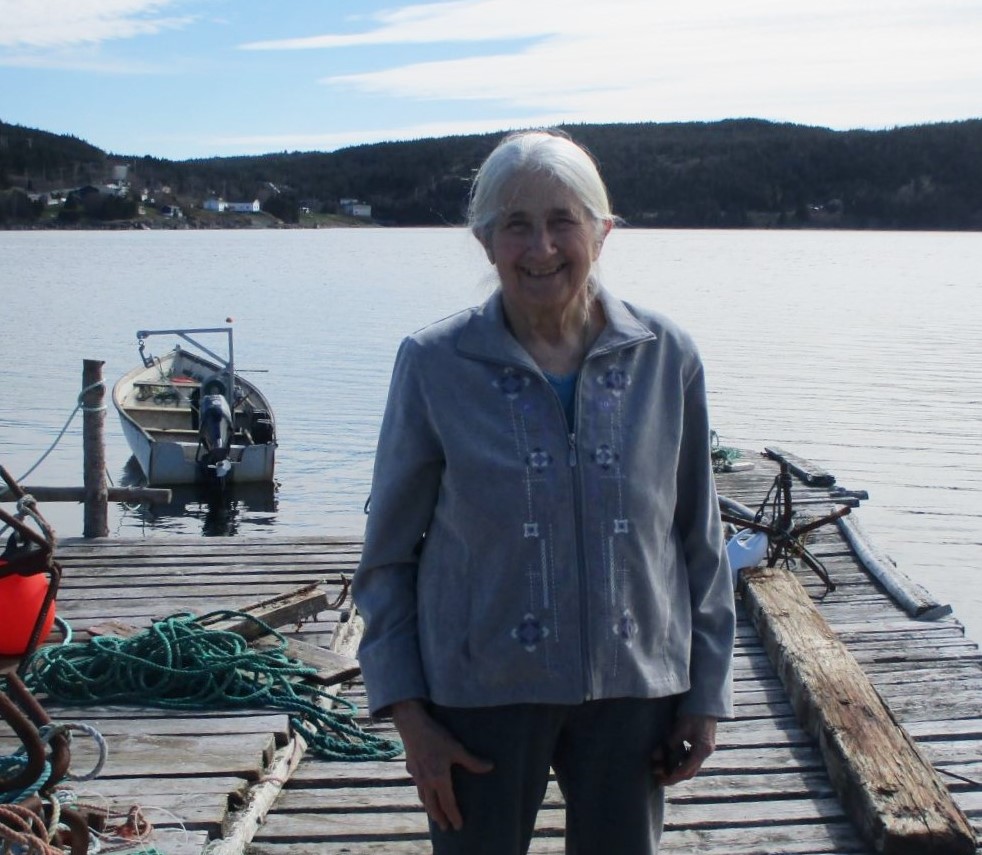
Helen Forsey: With roots in Newfoundland and the Maritimes, I was born and raised in Ottawa in a politically active family. I graduated in Agriculture from McGill’s Macdonald College, and worked for 18 years in international co-operation and solidarity in Latin America, West Africa and Canada. When my children were teenagers I joined an income-sharing intentional community in rural Ontario, where I farmed part-time and became further involved in networking with other activists. In 1991 I moved to another rural co-operative in Algonquin territory, working there for the next 30 years as an independent writer, translator and activist. In my articles and books on social, environmental and constitutional issues, I try to bring to bear a comprehensive feminist analysis, making connections visible and helping to shape solutions.
I started coming home to Newfoundland in the 1980s, and since 2003 I’ve spent part of every year at my little railway caboose at Cape St. Francis. In 2018 I met Barry Darby, and we discovered we shared similar approaches to public policy, social justice and grassroots democracy. Now, based at our home office in St. John’s, I’m able to put my skills and experience to use, working with him on our fishery policy initiative, “Changing Course,” and continuing my other writing.
Changing Course: The policy paper “Changing Course – A New Direction for Canadian Fisheries” evolved over recent years as Barry reflected on the fishery, its history and its current massive problems. Increasingly committed to this work, but without any clear idea of how to make that commitment count, he attended conferences, read extensively, and talked with people in political, academic and scientific circles as well as with fish harvesters. After a number of his letters on fishery issues were published in the St. John’s Telegram, he realized he needed to develop his ideas into a more comprehensive form – something he could present to the policy-makers and the broader public. The goal was to develop and promote a management system that would provide improved benefits and long-lasting sustainability.
By 2018 Barry had accumulated extensive notes and jottings on key aspects of this complex subject, and he and Helen began putting it together as a full-fledged policy proposal. In the spring of 2019 it was delivered to the federal Minister of Fisheries and Oceans, whose department, DFO, is in charge of Canada’s fisheries management. The proposal has since been distributed in various forms to a number of key parliamentarians, fishery workers, academics, media people and others for comments and response.
This website, launched in October 2019, makes our proposal and further material available to the wider public, offering the opportunity for further dialogue, which we also continue through the media and other means. We constantly network with interested groups and individuals, pursuing both official and unofficial responses to our ideas, and pushing towards implementation of the changes we recommend. Your input and suggestions are welcomed, and will help us move the process forward.
 Changing Course: A New Direction for Canadian Fisheries